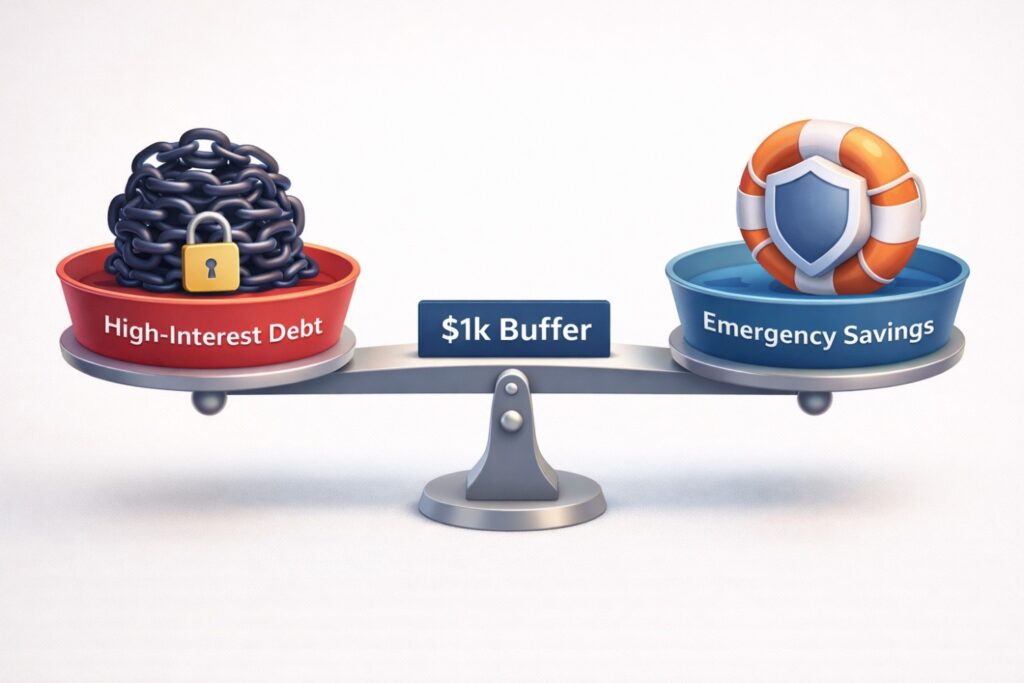
Looking at credit card debt side by side with an empty savings account is like being caught in a financial standoff. Which bill is calling out to you next? The high-interest debt that is screaming its needs, or the unknown, looming need for savings that is quietly sinister?
As a proud fixture at Smart Money Gate, I believe there isn’t a “○○○○” solution, but a personal order of priority, which comes from awareness. It isn’t about one versus the other; it’s all about strategically planning out your battle order. I’d love to walk with you through this fork in the road.
Understanding the Two Forces
Now, let’s introduce the participants of this tug-of-war game:
High-Interest Debt
This is usually debt with an interest rate higher than 7-8%, which may be on your credit card or payday loans. This is an active kind of erosion. It compounds daily, meaning your balance goes up even without parting with any amount. This causes your net worth to work at a loss.
Emergency Savings Buffer
This is the shock absorber for your finances. This is the money you stash away for the sudden, but important, expenses: fixing the car, doctor’s copays, vet bills, and the like. You measure the worth of an Emergency Savings Buffer not in the earnings, but in the prevented crises. With an Emergency Savings Buffer, any unexpected expense doesn’t put you into debt again.
The Core Dilemma: Math vs. Psychology
The purely mathematical argument is to pay off the high-interest debt aggressively. Why save $1,000 in the savings account earning 4%, when the debt is charging $22,000 to the wallet? “Saving” more by saving on interest.
But personal finance is a behavioral issue. The psychological case is equally valid. Without a small cushion of cash, you are one blown tire away from using the credit card again. This “one step forward, two steps backward” cycle is why so many people feel stuck.
This optimum strategy combines logic and behavioral concepts.
Your Awareness Check: A 3-Phase Framework
This is not a decision, it’s a staged mission. Employ your Financial Awareness Gateways to gather data.
Phase 1: The Essential Minimum Buffer (Your Financial Airbag)
Objective: Save $1,000-$2,000 immediately.
Before putting all your extra money towards debt, you need to create a minimum level of safety money. It is imperative to note that this is a non-negotiable step. The safety money is a small amount of money with a singular purpose: to take care of little, unexpected bills.
How to Fund It: Start by making just the minimum payments on all debts. All other money—side hustle income, tax refunds, budget slashing—should be deposited into a separate savings account until this first goal is reached. This is a ceasefire agreement between you and the cycle of debt.
Phase 2: The Aggressive Debt Assault
Objective: Knock out the high-interest debt with intense effort.
Having your minimum buffer in place, you can now devote 90% of your financial attention to your highest-interest debt, or what is known as the “debt avalanche”: prioritize your debts by interest rate, and go after it.
Your Tool: Your budget. Use your Expense Balance Gateway to figure out where your discretionary spending (“Wants”) can be temporarily allocated in order to make your “debt assault payment.”
The Mindset: This is a sprint focus. Each dollar repaid is an accomplished goal that cuts expenses for the long term.
Stage 3: Developing Overall Security
Objective: Build your emergency fund to a full 3-6 month Security Gateway.
Now that you’ve eliminated any high-interest debt, your financial situation looks completely different. What you used to pay to get out of debt is now what you’ll use to build wealth. Apply those significant payments to Phase 3.
Your Tool: Your Savings Buffer Gateway. Now, determine your real goal of 3-6 months of essential expenses, and work on it with the same passion that drove your debt elimination strategy.
The Result: You reach a state of complete foundational security. When you have no toxic debt and a well-stocked emergency fund, this happens.
Navigating Your Personal Scenario
Your individual circumstances refine this paradigm.
- If you have low interest rates on your debts (e.g., your house is at 3%, or your fed loan is at 4%): The numbers will work differently. It could make sense financially to complete your emergency fund savings before you pay off this low interest rate. Your safety net is often worth more than the interest you are saving.
- “If you’re living without an emergency fund and being pursued by collection agencies, Phase 1 is still important.” Financial triage begins with damage control. “A tiny safety net can mean the difference between a utility company cutting off your power or missing a payment that will cause more damage in the long run.”
- If you have a stable and high income but low spending: You might be able to handle both Phase 1 and Phase 2 at almost the same time, but keep in mind the principle of sequencing: first, buffer, and then attack.
The Smart Money Gate Insight: Use Your Gateways
This is the consequence of awareness. Walk through your gateways and find the fact:
- Expense Balance Gateway: It is necessary to know the monthly expense balance number. This is the target savings balance.
- Savings Buffer Gateway: Take an honest look at your current months of protection. Is it zero? Phase 1 is your absolute priority.
- The Calculation: All debts with their interest rates must be written down. This helps determine your “high-interest” target for Phase 2.
Final Thought: It’s a Sequence, Not a Choice
“Debt Payoff vs. Emergency Savings” is not an Either/Or choice. The best course of action is a planned sequence of steps: Minimum Buffer → Attack High Interest Debt → Build Full Security.
Through the adoption of such a phase awareness, you shield yourself from any rising crises while eliminating the existing ones. This approach respects the mathematical logic and the behavioral fact regarding the creation of long-lasting financial wellness. Begin with your buffer and target your debts as your destination.
Disclaimer: The contents of this post are only for Financial Awareness. Smart Money Gate does not provide Financial, Investment, or professional advice via Financial Awareness Gateways offered in Smart Money Gate. Financial decisions completely lie with you, with expert advice from a professional.
About the Author