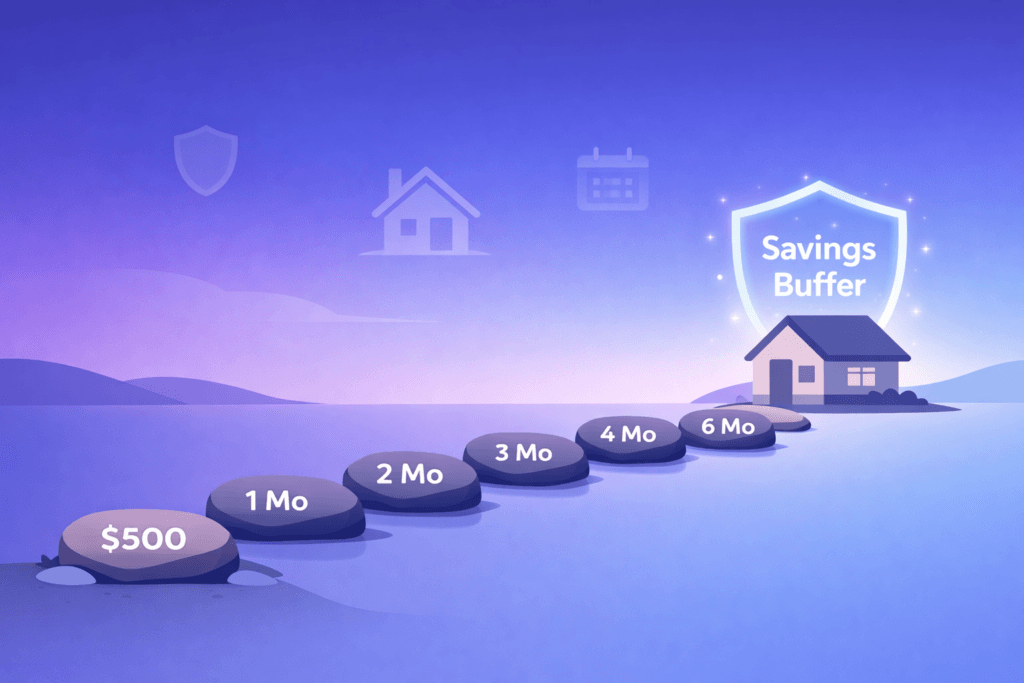
Having a 3 to 6 month savings buffer, known as an “emergency fund,” provides a financial foundation upon which a great deal of stability can be built. The thing is, creating such a cushion does not happen quickly, particularly with bills to pay, debt, and/or uncertain income to contend with. The good news: A windfall is not needed.
As Smart Money Gate, we don’t offer advice, but rather offer awareness through Financial Awareness Gateways. Therefore, this should be seen not as a prescription but as a step-by-step guide which you can walk on at your own pace.
Step 1: Start with Your “Essential Expenses” Not Your Total Spending
Your Savings Cushion is based on the total of your essential monthly expenses—the bare minimum costs to keep you housed, fed, and functional:
- Rent or mortgage
- Utilities (Electricity, Water, Basic Internet Access
- Groceries
- Minimum debt payments
- Transportation (car payment, gas, or public transit)$
- Basic Insurance (Health, Auto, Renters)
Remove the categories for eating out, subscriptions, shopping, and entertainment. Add up only the essentials for the past 3 months and then take an average. This would be your benchmark.
For instance, assuming your basic expenditures per month are $2,800, your target buffer will be:
→ 3 months = $8,400
→ 6 months = $16,800
Step 2: Start with a Mini-Buffer (If You Haven’t Already)
If you have little or no emergency savings on hand, it can be intimidating to immediately aim for a figure of $10,000+. That’s why most people who have success with saving first start off with what I like to call a mini-buffer with a sum.
This “safety cushion” prevents small crises, like a flat tire or a $200 doctor’s visit, from sidetracking you and sets you up for larger successes.
Step 3: Choose Your Target Timeline
This step involves asking yourself: “What is the level of resilience that I need?” The answer will depend on your risk profile:
3 months may be sufficient if you:
- Have stable, salaried employment
- Live in a dual-income household.
- Receive benefits through your employer for health benefits and paid leave
Try for 6 months, if you:
- Freelance, gig, or commission-based working
- Are the sole earner
- Must have chronic health needs or dependents
- Own a home (maintenance risks)
- Live in a high cost or volatile employment market.
Your goal will be: 3 months is the baseline, 6 months is the resilient point.
Step 4: Calculate Your Monthly Savings Rate
Divide your total buffer by the number of months you want to achieve that goal.
Example:
Ambition: $12,000 (4 months of $3,000)
Timeline: 24 months (2 years)
Monthly Savings Required = $12,000 ÷ 24 = $500/month
If $500 is too steep, just extend the timeline. Even with $150 per month, you’ll reach your goal in about 6.5 years. Quality over quantity.
Step 5: Automate & Isolate Your Savings
This step is important.
Open a separate high-yield savings account (FDIC insured, fee-free, liquid). Now:
- Automate a transfer on pay day
- Label this account “SAVINGS BUFFER – DO NOT TOUCH”
- Never connect it to your debit card
Segregation is both psychological and tangible—because segregated accounts protect your buffer against accidental disbursements.
Step 6: Use Windfalls Strategically
Speed up your momentum by applying unpredictable funds to your buffer:
- Refund claims
- Bonuses or side income
- Cash gifts or rebate payments
- Savings from canceled subscriptions
Even $100 increments, additions or what not, soon pile up.
Step 7: Reassess Every 6 Months
“Life can and does change. So must your buffer.”
Every 6 months, ask:
- Have there been any changes in my essential expenses? (for example, rent)
- Has the stability within my income increased or decreased?
- Have I acquired any new dependents or health issues?
Adjust your target accordingly. Awareness is a constant process.

Final Thought: It’s a Marathon, Not a Sprint
Saving for a 3-6 month “cushion” is about progress, not perfection. Some months, you’ll be able to save more. Other months, it’ll be less. What’s important is that YOU’RE MOVING FORWARD, setting up that “barrier” between you and financial panic.
“Because peace of mind is not something you can buy. It’s something you build, one dollar at a time.”
Disclaimer: This piece serves as an informative article and is not meant to be financial, investment, or professional advisory. Smart Money Gate delivers awareness via Financial Awareness Gateways, not as investment suggestions. Take professional financial guidance before making any decisions regarding personal finances.
About the Author