
Financial clarity for beginners means something simple yet powerful: you understand how your money flows. You know how much comes in, how much goes out, and where it’s going — without feeling overwhelmed or stressed. This clarity is the foundation of all good financial decisions and the first step toward long-term financial wellbeing.
Too many people struggle with money not because they earn too little, but because they don’t understand their money clearly. Sound familiar? If you’ve ever wondered why your balance feels low at the end of the month or why saving feels difficult, this guide is for you.
Financial clarity for beginners: What it truly means
Financial clarity is the ability to look at your personal finances and say, “Yes, I know exactly what’s happening with my money.” It’s not about strict budgets, complicated investments, or being perfect — it’s about awareness.
At its core, financial clarity helps you:
- Understand how much you earn and can actually use
- See where your money goes each month
- Recognize spending patterns
- Make confident decisions without fear
On SmartMoneyGate, tools like the Smart Finance Gateway give you a clear snapshot of your financial picture by calculating your cash flow, savings potential, and financial health score — all in one place.
Financial clarity for beginners vs budgeting — why clarity comes first
Many beginners jump straight into budgeting, thinking it will solve everything. But budgeting without clarity often feels like restriction and frustration rather than empowerment.
Imagine trying to build a house without first measuring the foundation. That’s what budgeting without clarity looks like. When you truly understand your financial baseline — your income, expenses, and spending rhythms — budgeting becomes a helpful tool, not a burden.
Financial clarity for beginners: Signs you might be lacking it
Here are some common feelings people have when they lack financial clarity:
- Checking your bank balance frequently and anxiously
- Feeling surprised by how much was spent
- Not knowing your monthly average expenses
- Saving only when there’s money left — which rarely works
- Avoiding looking at statements or transactions
These signs aren’t weaknesses — they’re clues that awareness is missing. The good news is that awareness can be built systematically, starting with simple steps.

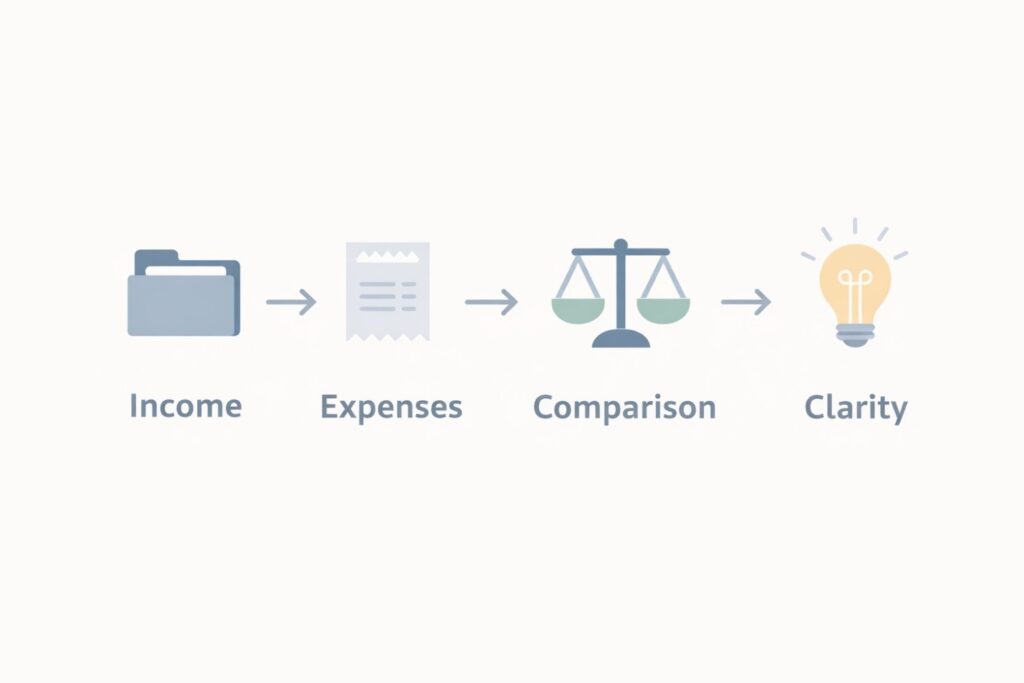
Financial clarity for beginners: Step 1 — Know Your Real Income
Your income is the foundation of your financial clarity. Don’t get stuck thinking about what you *should* earn or what might come later — focus on what you actually receive.
Ask yourself:
- What is my actual monthly usable income after taxes and deductions?
- Do I receive variable income or fixed income?
- Are there side earnings or irregular sources?
Once you know this number clearly, every other financial decision becomes easier.
Financial clarity for beginners: Step 2 — Know Where Your Money Goes
Understanding expenses is crucial. But ideally, don’t chase perfection — chase awareness. You can start by categorizing your expenses:
- Essentials: rent, food, utilities
- Flexibles: dining out, subscriptions
- Occasionals: travel, medical, gifts
For a stress-free analysis of your spending, try using the Financial Gateways Directory, which includes a suite of free tools to evaluate expenses, debt, savings, and cash flow.
This directory is especially helpful for beginners because it lets you compare numbers easily without feeling overwhelmed.
Financial clarity for beginners: Step 3 — Compare Income and Expenses
Once you have your income and expenses listed, the next step is to compare them directly. This simple exercise can be eye-opening.
Ask:
- Do I spend more than I earn?
- Which categories are largest?
- Are there patterns I didn’t notice before?
Seeing your finances in this straightforward way gives you clarity that reduces stress and supports better decision making. You might even consider using a comparison sheet in your notes or spreadsheet — this doesn’t need to be perfect; it just needs to be honest.
Financial clarity for beginners: Step 4 — Understand Your Saving Reality
Beginners often hear rules like “save 20% of your income.” But clarity doesn’t start with rules — it starts with reality.
Instead of asking how much you should save, ask:
- How much am I saving right now?
- Does this saving happen automatically or only when money is left?
Even if your current savings are low or zero, acknowledging that is part of clarity. From there, you can build small, sustainable improvements.
Financial clarity for beginners: Emotional benefits
One of the most noticeable effects of gaining financial clarity is emotional relief. When your money stops feeling chaotic and starts feeling understandable, stress drops.
Money clarity allows you to:
- Feel calmer about decisions
- Build confidence with numbers
- Stop avoiding financial check-ins
- Replace stress with strategy
For many beginners, this emotional shift is more transformative than mastering any budgeting technique or calculator.
Financial clarity for beginners: Tools that make awareness easy
SmartMoneyGate offers practical, beginner-friendly tools designed specifically for creating clarity without complexity.
- Smart Finance Gateway — Helps you assess cash flow, savings potential, and financial health all in one place.
- Financial Gateways Directory — Provides multiple calculators and assessments, including debt payoff and expenses.
- Smart Finance Guide — A practical article on simplifying money decisions with clear examples.
These tools are designed for clarity, not complexity — perfect for anyone just starting their financial awareness journey.
Financial clarity for beginners vs Financial discipline
It helps to think of clarity and discipline as separate but connected:
- Clarity — You understand your numbers
- Discipline — You make decisions based on that understanding
Clarity always comes first — you need to see clearly before you can act confidently.
Financial clarity for beginners in real life
To see how this works, imagine two friends with the same income:
Friend A never tracks expenses and feels stressed every month. Friend B knows their income, rough expenses, and where money tends to go — even if imperfectly.
The difference? Friend B has clarity. That makes a huge difference in confidence, decision-making, and overall financial peace.
Financial clarity for beginners: Common mistakes to avoid
As you develop clarity, watch out for these common traps:
- Trying to be perfect
- Tracking every cent obsessively
- Comparing your journey to others
- Skipping awareness and jumping to budgeting or investing too soon
Focus on consistency over perfection — even small awareness steps accumulate power over time.
financial clarity for beginners: How long does it take?
Financial clarity isn’t instant, but it doesn’t take forever either. Many beginners start seeing clarity within just a few weeks of regular check-ins.
- Basic clarity — a few weeks
- Comfortable awareness — 1–2 months
- Habitual clarity — 3+ months
The key is consistency — not intensity. Regular small steps beat occasional big efforts every time.
Financial clarity for beginners: Final thoughts
Financial clarity for beginners is not about perfection or pressure — it’s about understanding. Clarity reduces stress, improves decisions, and creates confidence. Before budgeting aggressively or making long-term plans, take the time to see your finances clearly.
When you understand your money, you stop reacting and start responding thoughtfully.
Financial clarity for beginners FAQ
What is financial clarity for beginners?
It means understanding income, expenses, and money behavior clearly without stress.
Do I need a budget to achieve financial clarity?
No. Awareness comes before budgeting.
Can financial clarity reduce money stress?
Yes. Understanding money reduces uncertainty.
Are tools necessary for financial clarity?
Simple awareness tools help, but complex systems are not required.
Is financial clarity the same as financial freedom?
No, financial clarity is not the same as financial freedom. Financial clarity refers to understanding your financial situation, including income, expenses, debts, and savings. Financial freedom, on the other hand, is the state of having sufficient personal wealth to live without having to work actively for basic necessities.
About the Author