
Let’s be honest for a quick second. Chances are, most of us didn’t have money management lessons as kids. Of course, we know how to make it. But know how to watch it grow without freaking out every time you open your bank app? Not so much.
This is where Smart Finance comes in.
And no, it’s not about learning how to be aWall Street wizard or even keeping track of every latte you spend. It’s about how you use better systems and better habits that will make finances less overwhelming and definitely more useful.
This is a no-BS explanation of Smart Finance and exactly how it works in the real world. It’s also a description of where people screw it up–and it’s more often than you might think–and just how the smartest finance technologies are leveling the playing field.
What’s Smart Finance (in Plain English)?
Essentially, intelligent finance is actually smart money management that works for you and with you.
It’s the idea that:
- You don’t have to be perfect
- You do need clarity
- And automation is your friend
Smart Finance combines smart financial planning, smart use of technology, smart knowledge of people, and smart flexibility. Smart Finance means less about strict budgeting, more about smart systems enabling smart decision-making without constantly being concerned with finances.
Instead of asking:
“How can I limit myself?”
Smart Finance asks:
“How can I make money more easily managed automatically?”
Everything changes once you discover who you are. Traditional advice on money no longer works.
Many traditional pieces of financial advice assume the following things about money:
- Stable income
- Predictable expenses
- Zero burnout
- Endless discipline
Which… come on.
There’s no sugarcoating it, modern life is messy. Side hustles. Subscriptions. Unpredictable income. Inflation. Unexpected expenses that come out of nowhere.
Smart Finance is effective because it is able to adapt to real-life situations. It employs resources, information, and intelligent strategies that are found in real-life living.
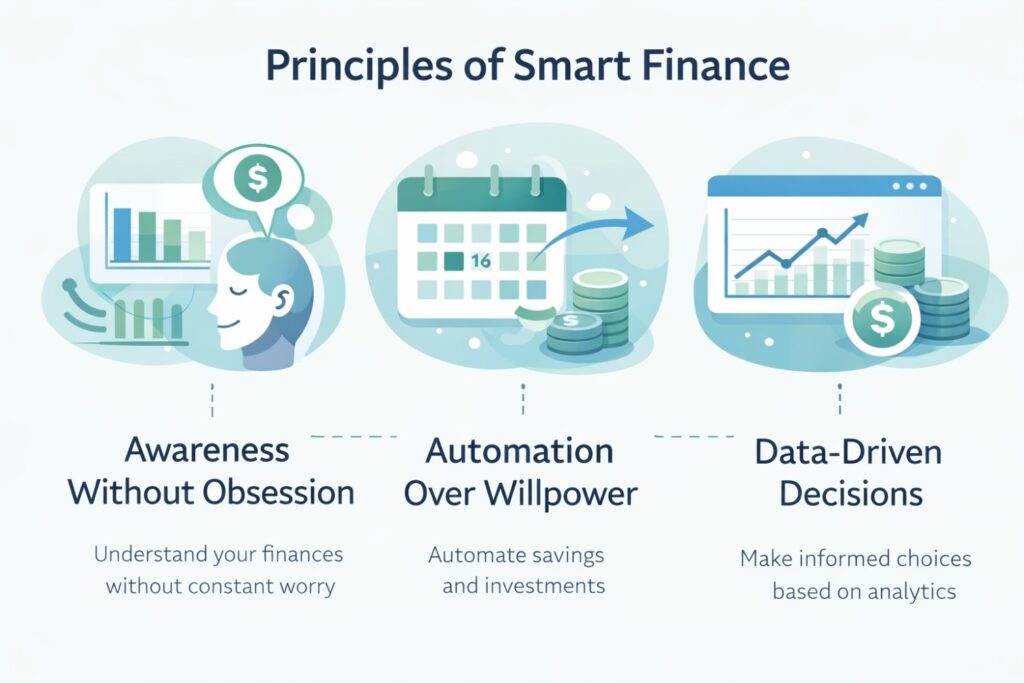
The Basic Principles of Smart Finance
1. Awareness Without Obsession
You don’t need to follow every penny. But it’s necessary to see where your money goes.
Smart Finance emphasizes:
- High-level cash flow awareness
- Better views than constant surveillance
- Weekly/Monthly meetings (Not Hourly Panic Attacks)
2. Automation Over Willpower
Willpower erodes. Systems won’t.
Here is where modern personal finance excels at:
- Auto savings strategy
- Auto-categorized Expenses
- Alerts instead of Spreadsheets
When systems handle the tasks, everything becomes effortless.
3. Decisions Based on Data, Not Guilt
Have you ever hesitated to check your account because you were afraid?
Yeah. Same.
Smart Finance is emotion judgment replaced with objective data. “You’re just not very good with money. What you lack is the right structure.”
Practical Examples of Smart Finance Systems In Action
Now, let’s apply this.
Example 1: The “Where Did My Money Go?” Problem
Instead of monitoring all transactions manually, Smart Finance features for you:
- Category Breakdowns
- Consumption habits
- There are clear trends
You don’t guess anymore. You know.
Example 2: Saving Without Feeling Broke
Using an It encourages:
- Micro-saving
- Automated transfers
- GOAL-BASE
There is no missing out because you continue to save without compromising your lifestyle.
Example 3: Planning Without Rigid Budgets
Instead of setting strict budget levels, Smart Finance emphasizes:
- Spending amounts
- Priority-based planning
- Month by month adjustments
Change is a part of life. Your financial system should adapt to this.
Common Smart Finance Mistakes (And What I Learned the Hard Way)
Nobody gets it right. Nobody. Seriously.
Error #1: Over-complicating
I once had: Three Spreadsheets, Five apps, Zero clarity.
Smart Finance is most successful if it is simple enough to be maintainable.
Error #2: Overlooking Cash Flow
Being frugal and feeling like you have no money boils down to having unorganized cash flow.
Smart Finance focuses on:
- Income and Expenditure Timing
- Liquidity (Not Just Totals)
- Short-term visibility
Error #3: Believing Tools Alone Can Correct Poor Behavior
Tools assist. However, they’re not magic.
Smart Finance is successful when tools enable good judgments, not replace responsibility.
How Smart Finance Tools Change the Game
“This is where things get interesting.”
The latest Smart Finance systems involve the following components:
- Real-time Data
- Clean dashboards
- Automated insights
Rather than being overwhelmed by numbers, you receive context.
The Smart Finance Gateway is one resource that might be worth looking into, and it makes several different money perspectives all come together in one integrated system. That’s helpful if you’d like one place to go for answers about what your money is really doing.
If you are interested, you can find it here:
Nothing is being forced upon you. It is only an alternative if you prefer to have things.
Kinds of Budgeting: Smart Finance vs. Traditional Budgeting
| Traditional Budgeting | Smart Finance |
|---|---|
| Strictly Defined Categories | Flexible Categories |
| Manual tracking | Automated insights |
| Guilt-based decisions | Data-based decisions |
| Time-consuming | Time-efficient |
This is why intelligent finance appeals to people who feel they’ve “failed” with budgeting in the past.
They did not fail. It is the system that did.
Future of Smart Finance
Smart Finance is not static; it’s changing rapidly. There’s much.
What’s Coming Next?
- AI-Powered Insights – Tools that do not merely indicate numbers but also help people understand them.
- Predictive Cash Flow – “Seeing problems before they happen.”
- Individualized Financial Coaching – “Personal guidance by automated systems based on real behavior, rather than generic information.”
intelligent finance is on the move towards being proactive in managing finances instead of being reactive when dealing with stress.
How to Start Implementing Smart-Finance Now (Without Changing Your Life)
Indeed, you don’t need a full reset.
Start Small:
- Gain visibility into your cash flow
- Automate One Savings Goal
- Use One Dashboard Instead of Five
- Check in weekly—not obsessively
If you’d rather have a structured way to begin, solutions such as Smart Finance Gateway can be used to consolidate things to the point where you’re not jumping between applications.
Here’s the link again in case you want to check it later:
FAQs
1. What is Smart Finance all about?
Smart Finance represents a contemporary method of managing finances, which applies automation, use of data, and dynamic financial planning to take more astute finance decisions.
2. Can everybody benefit from Smart-Finance?
Not at all. Smart-Finance is actually useful to people who have variable income because Smart-Finance is all about making money and cash flow easy to understand.
3. Do I need special tools to practice Smart-Finance?
Are there any tools, but they make the process easier. Awareness, automation, then platforms can be layered.
4. Smart Finance: What are the differences from budgeting?
The conventional budgeting method is rigid and does not have any automated processes. The Smart Finance system is flexible and automated.
5. Would Smart Finance assist in relieving money worries?
“Yes. Clear systems cut down uncertainty, and uncertainty is what creates most of the financial woes.”
Final Thoughts
Here’s the thing nobody tells you. You don’t have to be “good with money.” You need a system that understands the quality of human you are. Smart-Finance isn’t about limitation. It’s about awareness, alignment, and leveraging technology, such as AI-driven financial planning, to help shoulder some of the burden. As long as money is no longer a constant source of stress, all else becomes easier. And, you know, that’s the true victory.
Disclaimer
This article has been prepared solely for informational purposes. It does not provide professional advice on business matters. Prior to making business decisions, individuals should consult a professional.
About the Author