When you set up an emergency savings,
First, let’s talk about a scenario that might be a little more common. Perhaps you’re brand new to managing your finances and are living on a limited income. To you, the idea of saving for a stash may appear utterly impossible. But here is the thing: you don’t need to save thousands to get started. As a matter of fact, if you are a beginner on a small income, rather than trying to set aside 3-6 months of living costs, your goal actually should be one that’s much more reachable: a ‘mini-buffer.’
But at Smart Money Gate, we do not advocate-solutions; rather, we create awareness through Financial Awareness Gateways. So, as accurately and realistically as possible with no judgments being passed, let us address your Savings Buffer Gateways?
How much in emergency savings Dreamers of low income should begin with: keep it small.
But with someone on a lower income, the typical “3-6 month” rule does not apply. Instead, financial educators and real-world practices have agreed on this rule: start with $500-$1,000.
Why just this range? It’s enough to handle most of the probable small emergencies without blowing your budget:
The cost for repairing the car can amount to
An unexpected $200 bill to cover a medical co
A broken phone or appliance
Temporary utility shut-off prevention
Without having a single dollar in savings, these minor issues can quickly add up to either credit card debt at a high interest rate or a payday loan, costing much more later on down the road. Having one keeps you from being in that situation.
Why a Mini-Buffer Works for the Low-Income Beginner
However,
Building an entire emergency fund on a limited income may sound like trying to pour water into an already hole-y bucket. That’s why we propose our two-step process:Phase 1: Build the $500-$1,000
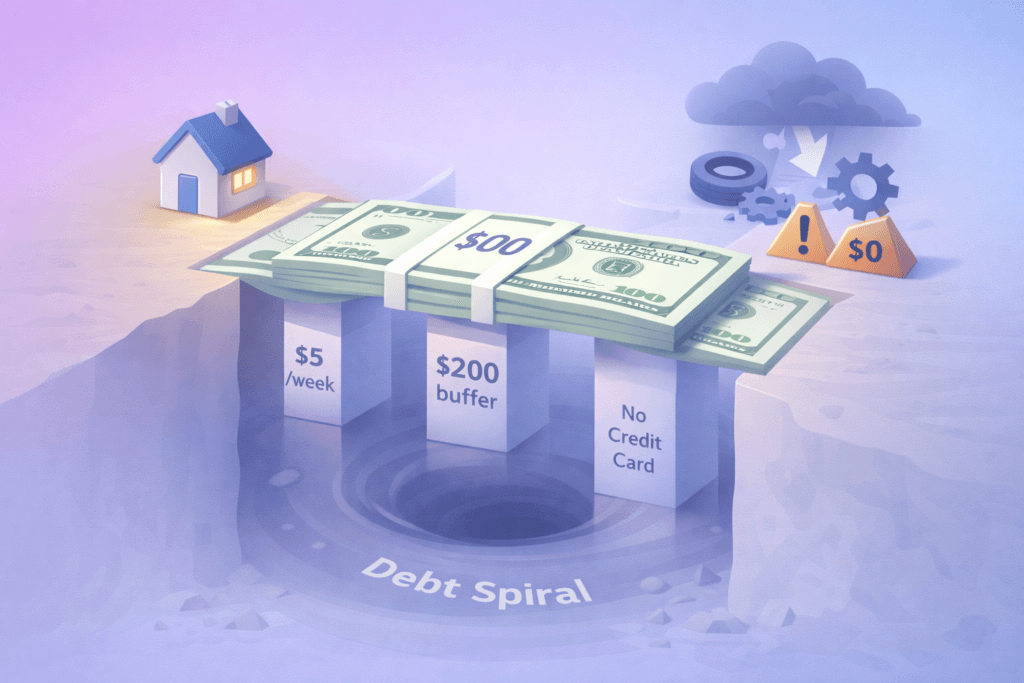
This is the “crisis cushion.” This prevents small problems from turning into spirals of debt. Phase 2: Scale to 3-6 Months Later
Savings can be built up when high-interest debt is managed. This is after there is a stabilization of income.
This is an achievable, sustainable solution-an empowering plan that builds pride. Each dollar of savings is a move toward resiliency.
How to Build Your $500 Buffer – Even on a Budget
You don’t have to have tons of money on hand, just be consistent. StartFrom $5/week to $260/year Use round-up apps for saving loose change – optional, and only if privacy settings allow Manage small windfalls: tax refunds, gift money, side hustle funds Park it in a separate account: Free high-yield savings account (FDIC-insured, no fees)
Don’t pay high-interest debt until you have at least $500 in an account.
Remember, it is not about being perfect. It is about prevention. Spending as little as $200 may just stop you from reaching out and using your credit card in panic.
Savings Buffer Gateway for Low-Income Beginners by Smart Money Gate
Ask yourself this gateway question:
Change your
“How many weeks of living expenses would be covered by my current savings if my income was suddenly lost?” Use of the following simplified formula: Mini-Buffer Objective = $ 500 Weeks of Coverage = $500 ÷ WEEKLY ESSENTIAL EXPENSES For example, if your essential expenses a week are estimated at $150, a buffer of $500 equates to 3.3 weeks of coverage. This is often sufficient to get you through until you find another job or deal with that family emergency.
What Your Emergency Fund Is NOT For (especially on low income)
_______________________________________________________
To protect your hard-earned buffer, remember:
❌ Not for discretionary spending: holidays, birthdays, clothes, Netflix
✖ Not for known expenses: annual dues, car registration, holiday presents
√ For true emergencies only: unexpected, urgent, and unavoidable
You have to treat the mini-buffer as sacred. That way, it’ll be there if you ever actually need it
Final Thought: Security Starts Small
By: Nick
Thus, How Much Emergency Savings for Newbies with Low Income?
Enough to take out the domino effect. $500. $1,000, maybe. First, financial success. Because peace of mind isn’t something that high-income earners have the copyright to. Peace of mind is built dollar by small dollar.
Disclaimer: This content is for informational purposes only and should not be considered as financial or investment advice. Smart Money Gate provides awareness through Financial Awareness Gates and in no way is this investment or professional advice. Always seek advice concerning your finances from a qualified financial advisor.
About the Author